
Table of Contents
- How Long Does Office Painting Take? Realistic Ranges
- A Transparent Commercial Office Painting Timeline, Task by Task
- What Stretches Project Duration: Rooms, Square Footage, Coats, and Crew Size
- Office Painting Preparation Checklist
- Office Painting Drying Time: Recoat, Cure, and Safe Re-Entry
- Painting an Office While Occupied: Phasing and Business Continuity
- Estimating Your Own Timeline: Square Footage, Crew Size, and Labor Hours
- Delay Risks and Contingency Planning
- Frequently Asked Questions
Last Updated: October 21, 2026
How Long Does Office Painting Take? Realistic Ranges
Most office painting projects take between three days and three weeks. The exact number depends on square footage, prep work, coats, and how many painters are on site.
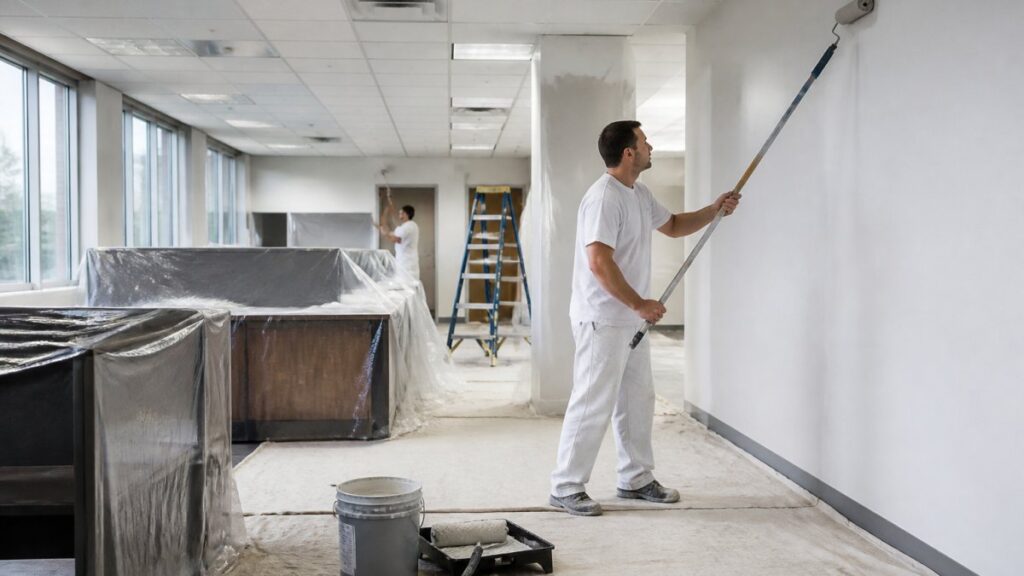
Office painting is the process of preparing, priming, and coating interior commercial walls, ceilings, and trim while keeping the business running.
Below, we break down realistic timelines by office size, then show exactly where the days go.
Small, Medium, and Large Office Timelines
A small office suite of up to 2,000 square feet usually finishes in two to four working days. A medium office of 2,000 to 8,000 square feet typically runs one to two weeks. A large open-plan floor above 8,000 square feet often needs two to four weeks, especially when work happens in phases.
These ranges assume normal ceiling heights, light prep, and a two-coat system. Heavy patching or after-hours-only access pushes every range longer.
Estimated Duration by Office Size
| Office Size | Square Footage | Typical Duration | Typical Crew |
|---|---|---|---|
| Small suite | Up to 2,000 sq ft | 2-4 working days | 2-3 painters |
| Medium office | 2,000-8,000 sq ft | 1-2 weeks | 3-5 painters |
| Large open-plan floor | 8,000-20,000 sq ft | 2-4 weeks | 5-8 painters |
| Multi-floor or phased | 20,000+ sq ft | 4-8 weeks | Rotating crews |
Treat this as a starting point, not a promise. A walkthrough turns these ranges into a real schedule.
A Transparent Commercial Office Painting Timeline, Task by Task
A commercial office painting timeline breaks into six stages, and each one has a predictable duration once you know the square footage and crew size. The table below shows how the days actually stack up on a typical 5,000-square-foot office with normal ceiling heights, light prep, and a two-coat system.
| Stage | What Happens | Typical Duration (5,000 sq ft, 4 painters) | What Drives the Number |
|---|---|---|---|
| Walkthrough and written scope | Measure rooms, note surface condition, confirm colors and sheens | 1-3 days before work starts | Number of distinct rooms and finish selections |
| Protection and setup | Move furniture, cover floors, seal work zones | 4-8 labor hours (half a day to one day) | Furniture density, floor type, number of zones |
| Surface preparation | Clean, sand, patch, and repair | 16-32 labor hours (two to four days) | Condition of existing walls, number of repairs |
| Priming | Spot-prime repairs and stain-block | 4-8 labor hours (half a day to one day) | Repair volume, stain blocking needs |
| Paint application | Two coats over walls, ceilings, and trim | 40-64 labor hours (five to eight days) | Coats, ceiling height, trim linear footage |
| Cleanup and final walkthrough | Remove protection, touch up, walk the space | 4 labor hours (half a day) | Punch-list length, furniture reset |
How the Hours Convert to Calendar Days
Labor hours are not the same as calendar days. A 5,000-square-foot office with 80 total labor hours does not finish in 80 hours divided by four painters (20 hours, or 2.5 days) because drying and recoat windows sit between stages.
The rule of thumb: add 30-40% to raw labor hours to account for recoat windows, staging, and the natural friction of moving between rooms.
A Worked Example: 5,000 Square Feet, Four Painters
- Day 1: Walkthrough already complete. Crew protects floors and furniture in Zone A (about 1,500 sq ft).
- Days 2-3: Prep and patch Zone A. Prime repaired areas.
- Days 4-5: First coat Zone A, then second coat after recoat window. Crew shifts to protect Zone B.
- Days 6-7: Prep and paint Zone B while Zone A dries and gets touched up.
- Days 8-9: Zone C prep and two coats.
- Day 10: Final touch-ups, protection removal, walkthrough.
That sequence assumes the office can be split into three zones and that each zone can be vacated for two to three days. If the office must stay fully occupied, the same job stretches to two weeks or more because work happens in smaller windows.
Ask for the schedule in writing, task by task, with labor hours per stage. A contractor who can’t break the job into stages usually hasn’t planned the prep, and prep is where timelines slip.
Where the Calendar Actually Goes
Across most office projects, paint application is the largest single block of labor hours, but prep and recoat windows consume the most calendar days. A job with heavy patching can spend 40% of its schedule before the first full coat goes on. That is why two offices of identical square footage can differ by a week: the walls, not the paint, set the pace.
What Stretches Project Duration: Rooms, Square Footage, Coats, and Crew Size
Four variables drive almost every delay: the number of rooms, total square footage, the number of coats, and crew size. A fifth, surface condition, can quietly add days on its own.
More rooms means more cutting in, more trim, and more edges. Square footage sets the raw wall area. A third coat adds a full dry-and-recoat cycle. A larger crew shortens the calendar but only up to the point where the space can hold them.
Surface Condition, Prep, and Repairs
Walls in poor shape change the math. Peeling paint, water stains, drywall cracks, and old patching all need attention before a brush touches the wall. Each repair adds sanding and drying time.
In practice, prep is where most schedule overruns begin. A wall that looks fine under office lighting can hide years of quick fixes.
Office Painting Preparation Checklist
Good prep protects your timeline and your furniture. Use this checklist before painters arrive:
- Confirm colors, sheens, and which surfaces get painted
- Clear personal items from desks and shelves
- Label anything that must not move
A written scope should list every item above. Clear scopes are how we keep projects of different sizes on schedule.
Office Painting Drying Time: Recoat, Cure, and Safe Re-Entry
Office painting drying time splits into three separate clocks, and mixing them up causes problems. Recoat time is when a second coat can go on. Cure time is when the coating reaches full hardness.
Latex wall paint usually accepts a second coat within a few hours. Full cure takes longer, often several days to a week. Safe re-entry depends on ventilation, temperature, and humidity, and it usually comes well before full cure.
Reoccupying a room too early traps solvent and moisture. It also risks scuffing a finish that hasn’t hardened. Plan re-entry around ventilation and dry time, not around the paint feeling dry to the touch.
Temperature and humidity matter here. Cool, damp conditions slow both recoat and cure. Good airflow speeds re-entry.
Painting an Office While Occupied: Phasing and Business Continuity
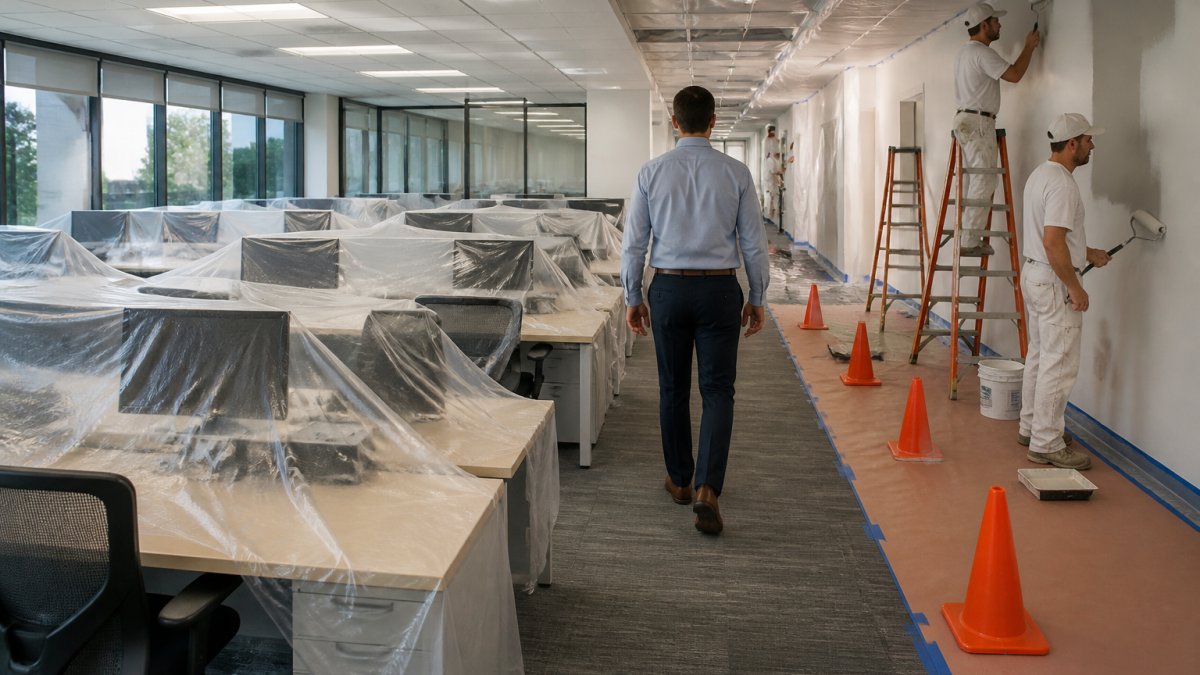
Painting an office while occupied is entirely workable with phasing. The goal is simple: keep desks, customers, and workflows running while one zone gets painted at a time.
How to Size and Sequence Zones
A workable zone is the smallest area a crew can protect, prep, and coat in two to three working days without trapping employees. In practice that is usually 1,000 to 2,500 square feet, or one wing, one floor, or one cluster of rooms served by a single corridor.
Sequence zones so the least disruptive areas go first. That gives your team time to adjust to the routine before reception, dining, or other high-traffic spaces are touched.
After-Hours and Weekend Trade-Offs
After-hours and weekend work keeps high-traffic areas like reception and dining spaces open during business hours, but it carries real trade-offs. Crews working nights and weekends cost more per labor hour, and inspection is harder because the people who approve the finish are not on site.
For restaurants and retail, the schedule follows your operating hours. That’s a planning conversation, not an obstacle.
Ventilation, Noise, and Air Quality
Ventilation is the part of occupied painting that most schedules ignore. Low-odor and zero-VOC latex paints reduce smell, but they still release moisture as they dry, and enclosed zones need airflow to hit recoat and re-entry times. Plan to:
- Keep HVAC running in occupied areas and isolate returns near the work zone.
- Use negative air pressure or fans to push air out of the painted zone, not into occupied desks.
- Confirm any HVAC shutdown windows in writing before the crew arrives.
Noise follows the same logic. Sanders, sprayers, and lifts are the loudest stages, so place them in zones farthest from focused work or schedule them outside core hours.
Re-Entry Criteria for Staff
Staff can usually return to a painted area once the coating is dry to the touch and ventilation has cleared the space, which for standard latex wall paint is often the same day or the next morning. Full cure takes longer, often several days to a week, but cure is not the same as safe re-entry. Set re-entry around dry-to-touch plus airflow, not around the calendar.
The best continuity plan paints the least disruptive zones first, isolates air and noise, and sets a clear re-entry rule. That combination keeps the business running without rushing the finish.
Estimating Your Own Timeline: Square Footage, Crew Size, and Labor Hours
You can build a rough estimate before anyone visits. Multiply the wall area by the number of coats, then divide by what one crew can cover in a day.
A practical formula:
Labor days = (paintable square footage × number of coats) ÷ (crew size × daily coverage per painter)
Daily coverage per painter varies with ceiling height, trim, and obstacles. A rough starting figure is a few hundred square feet of wall per painter per day on straightforward walls.
Run the formula twice: once for a two-coat job, once for three. The difference is your buffer.
Delay Risks and Contingency Planning
Delays come from a short list of causes. Knowing them lets you plan around them.
- Hidden surface damage found after furniture moves
- Color or sheen changes approved late
- Humidity and temperature slowing dry times
- Access limits from security, HVAC, or busy periods
Build a two-to-three day buffer into any project over a week.
Schedule the final walkthrough before work starts. A fixed sign-off date keeps small punch-list items from stretching the project by a week.
Every office painting project runs on the same three levers: prep, dry time, and access. Get those right and the calendar holds.
If you’re planning a refresh and want a schedule you can trust, Coast Painting brings more than 40 years of commercial painting experience to every walkthrough.
Get a free estimate from Coast Painting and get a realistic timeline before you commit.
Frequently Asked Questions
Can an office be painted in one day?
A single small office suite, roughly one or two rooms with simple walls and ceilings in decent condition, can sometimes be painted in one day if the crew is large enough and only one coat plus primer is needed. Most offices need two coats with recoat time in between, plus prep, moving, and cleanup, so a full day is tight. Plan for two to three days for anything beyond a single small room.
How long should paint dry before an office can be used?
Latex wall paint is usually dry to the touch in about one hour and ready for a second coat in two to four hours. You can typically use the space the same day once the final coat is dry to the touch and ventilation has cleared the smell, though it stays soft for several days. Oil-based and specialty coatings need longer, often 24 hours or more before regular use. Ask your painter for a specific re-entry time based on the product used.
What factors affect how long commercial painting takes?
The biggest factors are total square footage, the number of rooms and separate work areas, surface condition, and how much prep is needed. Ceilings, trim, doors, and specialty finishes add time. Crew size changes the schedule directly, as does the number of coats. Drying and recoat time set a floor no crew can beat, and occupied-office phasing, after-hours work, and furniture moving all stretch the calendar.
How can a business minimize disruption during office painting?
Phase the work by zone so staff relocate rather than leave entirely. Schedule noisy prep and odor-heavy work after hours or on weekends. Move furniture in advance and clear wall access before the crew arrives. Confirm ventilation and re-entry times per room, and get the phasing plan in writing before work starts. A written schedule that names each zone and date keeps operations running and prevents surprises.