
Table of Contents
- Start With Your Siding and Climate, Not the Color Chip
- Acrylic vs. Latex Exterior Paint: What the Labels Actually Mean
- How Long Does Exterior House Paint Last?
- Exterior Paint Surface Preparation Decides the Lifespan
- Application Details That Add Years: Coats, Sheen, and Weather Windows
- Exterior Paint Warranty Coverage: Read the Fine Print First
- Cost Over the Full Repainting Cycle
- Conclusion
- Frequently Asked Questions
Last Updated: October 17, 2026
Start With Your Siding and Climate, Not the Color Chip
Most homeowners pick a color first. At Coast Painting, we have spent over 40 years coating homes, wineries, and commercial buildings, and we can tell you: the chip is the last decision, not the first.
Choosing long lasting exterior paint starts with two questions. What is under the paint? What will hit it every year? Answer those, and the product list shrinks fast.
Match the Coating to Wood, Fiber Cement, Stucco, and Metal
Each surface holds paint differently.
- Wood siding: It expands and shrinks with moisture. You need a flexible coating that moves with it.
- Fiber cement: It soaks up water and can chalk. A good exterior primer does most of the work here.
- Stucco: It is porous and hairline-cracks. Elastomeric or high-build acrylics bridge small cracks.
Put the wrong product on a surface and no warranty will save you.
How Sun, Humidity, and Temperature Swings Change the Answer
Coastal fog, inland heat, and cool nights all stress a coating in different ways. High UV exposure breaks down resin and fades color. Constant humidity slows curing and invites mildew. Big day-to-night temperature swings cause the film to flex.
A paint that lasts 12 years on a shaded north wall may fail in 6 on a sun-baked south wall. Climate is half the decision.
Acrylic vs. Latex Exterior Paint: What the Labels Actually Mean
Here is the short answer: 100% acrylic is the top tier, and “latex” is a broad family that includes it. The label tells you more than the marketing name.
Acrylic paint is made with acrylic resin.
Read the can closely:
- “100% acrylic” means the binder is fully acrylic. Best for sun and moisture.
- “Acrylic latex” is a blend. Good, but check the solids content.
- “Vinyl acrylic” costs less and lasts fewer years.
For most homes, a 100% acrylic latex is the smart pick. The U.S. EPA’s guidance on volatile organic compounds also matters here, since lower-VOC acrylics are easier to apply safely.
How Long Does Exterior House Paint Last?
Exterior house paint lasts roughly 5 to 10 years on most homes, and longer on well-prepped surfaces with a high-quality 100% acrylic. The range is wide because surface, climate, and prep matter as much as the product.
Here is how the variables stack up:
|
Factor |
Shorter Lifespan |
Longer Lifespan |
|---|---|---|
|
Surface |
Bare wood, metal |
Prepped fiber cement, stucco |
|
Sun exposure |
Full afternoon sun |
Shade or partial sun |
|
Prep quality |
Minimal scraping |
Full wash, sand, prime |
|
Coating |
Vinyl acrylic |
100% acrylic |
|
Coats |
One |
Two or more |
A repainting interval of 7 to 10 years is a realistic target for a properly prepped acrylic job. Cheap paint on a dirty wall can fail in half that time.
How to Read Lifespan Claims and Test Evidence
Manufacturers throw around big numbers, but those numbers come from very different kinds of evidence. Knowing which is which keeps you from overpaying for a promise the product cannot keep.
- Laboratory testing measures a coating under controlled conditions: accelerated weathering machines that cycle UV, heat, and moisture, or adhesion and flexibility tests on prepared panels. Lab results are useful for comparing formulas, but they rarely match a real wall that gets afternoon sun, sprinkler spray, and freeze-thaw cycles.
- Field studies expose painted panels or test fences to real weather over years. They are closer to reality, but a test fence in one climate does not predict performance in another. Ask where the study was run and for how long.
- Warranties are a legal promise, not a test result. A “lifetime” warranty usually means the life of the coating as the maker defines it, and it typically covers product replacement, not labor. Read the limits before you treat a warranty as a durability rating.
A practical rule: treat a manufacturer’s lifespan claim as a ceiling, not an average. Plan your repainting budget around the lower end of the realistic range for your surface and exposure, and treat any extra years as a bonus.
What Actually Shortens Service Life
Most premature failures trace back to a handful of causes, and none of them are the color you picked:
- Moisture behind the film from leaks, poor caulking, or interior vapor drives peeling from the bottom up.
- Painting outside the temperature and humidity window prevents proper film formation, so the coat never fully cures.
- Inadequate prep leaves chalk, dirt, or loose paint that the new coat cannot bond to.
Fix the cause before you repaint, or the new coating inherits the old problem and the clock resets to zero.
Exterior Paint Surface Preparation Decides the Lifespan
Preparation is where most paint jobs are won or lost. A premium coating on a dirty, chalky wall will peel. A mid-grade coating on a clean, primed surface will hold for years.
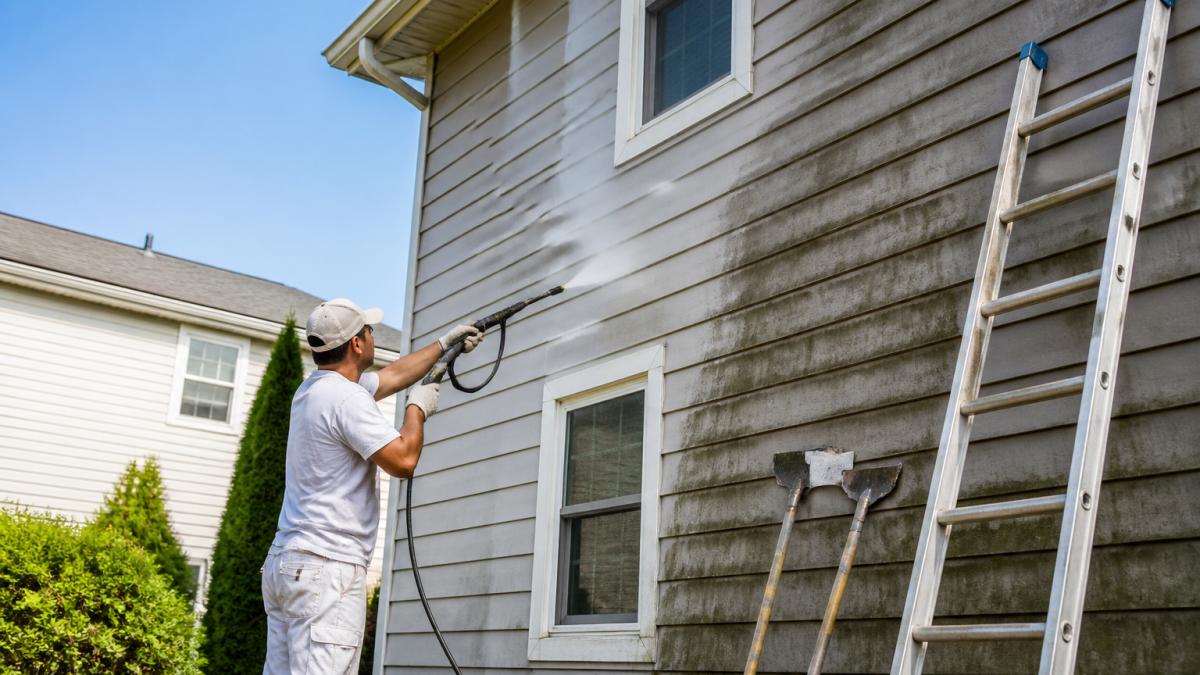
The core steps are simple but non-negotiable:
- Power washing to strip dirt, chalk, and mildew
- Scraping loose and blistered paint
- Sanding edges so the new coat bonds flat
Skip any of these and adhesion suffers. Paint fails from the bottom up, not the top down.
Diagnose Existing Failure Before You Repaint
Look at how the old coat failed. It tells you what to fix.
- Peeling usually means moisture trapped behind the film or poor adhesion.
- Blistering points to painting in direct sun or on a damp surface.
- Cracking and checking signal an old, brittle coating that lost flexibility.
Fix the cause, or the new paint repeats the old failure.
Application Details That Add Years: Coats, Sheen, and Weather Windows
A single coat leaves thin spots that fail first. Two proper coats build a thicker, more even film with better fade and moisture resistance.
Sheen matters too. Satin and semi-gloss shed dirt and resist moisture better than flat. Flat hides surface flaws but collects grime.
Then there is timing. Paint needs the right conditions to cure:
- Temperature: usually above 50°F and rising
- Moisture: no rain in the forecast for the drying window
- Sun: avoid painting in direct heat, which causes blistering
Get the weather window wrong and a good coating performs like a bad one.
Exterior Paint Warranty Coverage: Read the Fine Print First
Most exterior paint warranties cover defects in the coating, not labor. That distinction matters. If a product fails, the maker may replace the paint. It rarely pays to strip and redo the job.
Watch for these limits:
- Lifetime often means the life of the coating, not your ownership.
- Labor is usually excluded or capped.
- Void conditions include poor prep, wrong primer, or application outside the temperature range.
A warranty is only as good as the prep behind it. Document your process, and keep the product data sheet.
What a Warranty Actually Covers
Paint warranties are written to protect the manufacturer, not the homeowner. The coverage usually falls into three buckets:
- Product replacement is the most common remedy. The maker supplies new paint, and you or your painter cover everything else.
- Labor reimbursement is rare and usually capped at a fraction of the repaint cost, if it exists at all.
- Exclusions do the heavy lifting. Poor surface preparation, moisture intrusion, substrate failure, and application outside the published temperature range are standard reasons a claim is denied.
That means the warranty is not a durability rating. It is a limited remedy for a narrow set of defects, and it is almost always conditioned on following the maker’s written application instructions to the letter.
How to Protect a Claim Before You Need One
A warranty you cannot document is a warranty you cannot use. A few habits keep a claim viable:
- Keep the product data sheet and the receipt. The data sheet lists the required primer, spread rate, and application conditions.
- Record the prep steps. Photos of the washed, scraped, and primed surface show the work was done.
- Note the weather. Temperature, humidity, and dry time at application are common claim questions.
Warranty vs. Real-World Durability
A long warranty is not proof of a long-lasting coating. Some makers offer generous terms because the exclusions are narrow and the remedy is limited to product. Others offer shorter terms on coatings that perform well in the field.
The better comparison is cost over the full repainting cycle. A premium acrylic with a modest warranty that holds 8 to 10 years on a prepped wall usually beats a cheaper coating with a flashy warranty that fails in 5.
Cost Over the Full Repainting Cycle
A cheaper can is not a cheaper job. Price per gallon tells you little. Cost per year of service life tells you everything.
Do the math on the full cycle:
- A low-cost coating that lasts 5 years costs more over a decade than a premium acrylic that lasts 10.
- Labor dominates the bill. Repainting twice doubles the labor, not the paint cost.
- Prep and primer add upfront cost but stretch the service life.
When you weigh repainting interval against upfront price, the high-quality paint usually wins. At Coast Painting, we quote each project on its own surfaces and exposure, since pricing depends on size, prep, and access. OSHA’s guidance on fall protection for work at height shapes how we plan safe access on taller buildings, which affects the plan too.
Conclusion
The hard part is not picking a color. It is matching the coating to your siding, your climate, and a prep job done right.
That is the work Coast Painting does every day. We have coated everything from family wineries to major commercial and institutional properties throughout the Central Coast.
Ready to protect your property with a finish that lasts? Get a free estimate from Coast Painting and start with a coating built for your walls and your weather.
GET A FREE ESTIMATE!
Frequently Asked Questions
What type of exterior paint lasts the longest?
A 100% acrylic exterior paint generally outlasts other options on most siding, holding color and flexing with temperature changes without cracking. On bare wood or chalky surfaces, a matching exterior primer underneath is what makes the topcoat last. Oil-based paint still has a place on some metals and for stain blocking, but it chalks and loses gloss faster in high sun. The longest-lasting result comes from the right coating paired with correct surface preparation and two full coats.
Is acrylic or latex paint better for exterior surfaces?
Most exterior paint sold as latex is already acrylic or a styrene-acrylic blend, so the real question is the acrylic percentage. Higher acrylic content improves adhesion, flexibility, and fade resistance, which matters on wood siding and in high-UV climates. Read the label: a 100% acrylic product is the top tier, while a vinyl-acrylic or plain latex is a budget option. For repainting interval, the 100% acrylic usually wins.
How important is surface preparation for exterior paint durability?
Preparation is the single biggest factor in how long the job lasts. Power washing, scraping loose paint, sanding edges, caulking gaps, and spot priming take longer than rolling on color, but skipping them causes peeling, blistering, and cracking within a few seasons. Paint adheres to a clean, sound surface, not to chalk, dirt, or failing layers. A crew that rushes prep is the most common reason a repaint fails early.
What should I check in an exterior paint warranty?
Look at the length, what it actually covers, and the conditions that void it. Most manufacturer warranties cover peeling and blistering but exclude cracking, chalking, and fading, and many require application over a properly prepared surface with a specified primer and coat count. Labor is often excluded. Ask for the written warranty before the job starts, and keep the product data sheet so you can show the coating was applied as specified.